Feature Trees vs Screening Plants: Which Is Best for Your Sydney Garden?
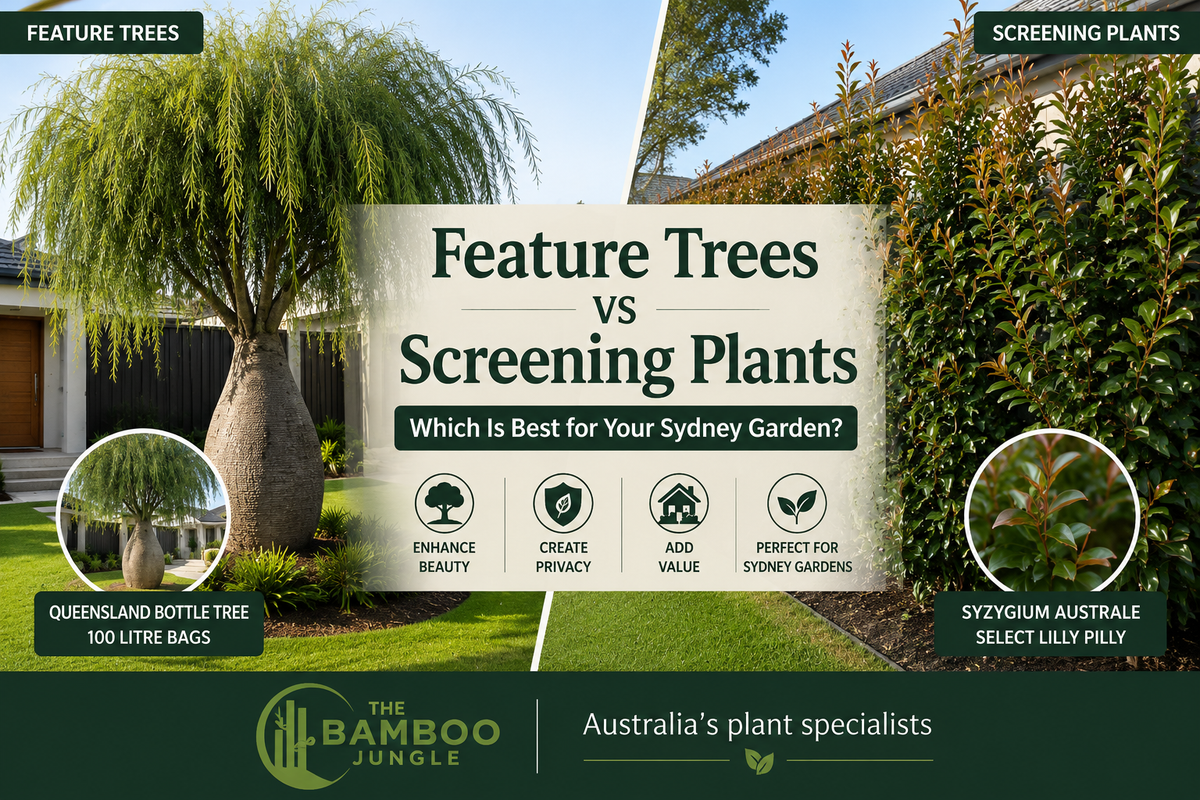
This is one of the most common questions Sydney gardeners face when planning a new outdoor space. You have a garden that needs work. You want privacy in one corner, a focal point near the entrance, and something green that does not demand constant attention. Do you plant feature trees? Screening plants? Both?
The honest answer is that most well-planned Sydney gardens use both. But they serve different purposes, they go in different spots, and choosing the wrong one for the wrong location is a mistake that takes years to undo. This guide cuts through the confusion so you know exactly what to plant, where, and why.
Key Takeaways
- Feature trees create focal points. Screening plants create privacy. Both serve different purposes in the same garden.
- The best feature trees for Sydney gardens suit the local climate and need minimal intervention once established.
- Evergreen screening plants in Sydney give year-round coverage, which deciduous alternatives do not.
- Low maintenance options exist in both categories. The right choice comes down to placement, space, and sun exposure.
- Most well-planned Sydney gardens use feature trees and screening plants together, not one or the other.
What Is a Feature Tree and What Does It Actually Do?

A feature tree is a plant chosen to draw attention. It sits at the centre of a space, anchors a garden bed, frames a driveway, or stands alone as the main visual element of a front or back garden.
The best feature trees for Sydney gardens do this through one or more of the following: an interesting growth form, striking foliage colour, seasonal flowers, or an unusual texture that reads well from a distance. They are chosen to be noticed.
In practical terms, garden feature trees in Sydney need to suit the local climate. Sydney summers are hot and dry. Winters are mild but can bring heavy rain. The plants that perform year after year here are ones that handle both without much intervention.
What Are Screening Plants and When Do You Need Them?

Screening plants do the opposite job. They are not there to be looked at. They are there to block the view, reduce noise, create a green wall along a fence line, or separate one area of the garden from another.
The best screening plants for Sydney are dense, fast-growing, and evergreen. You want year-round coverage, not a deciduous plant that drops its leaves in winter and leaves your garden exposed for six months. Evergreen screening plants in Sydney also handle wind better and maintain their structure across the full year.
Where feature trees work as single specimens, screening plants are usually planted in rows or groups. The goal is coverage, not display.
The Key Differences Side by Side
Purpose: Feature trees draw attention and create focal points. Screening plants block views and create privacy.
Placement: Feature trees work as standalone specimens near entrances or in raised garden beds. Screening plants go along boundaries and fence lines.
Maintenance: Low maintenance feature trees need little beyond an occasional prune once established. Low maintenance screening plants need a trim once or twice a year to stay tight along a boundary.
Timeline: Feature trees make an immediate impact. Screening plants take one to two growing seasons to reach full coverage, though fast-growing varieties close the gap considerably.
How to Choose What Your Sydney Garden Actually Needs

Start with these three questions.
What problem are you solving?
If you are looking at a neighbouring roofline, a busy street, or an overlooking window, you need screening plants. If you are looking at a bare patch of lawn that needs something to anchor it, you need a feature tree.
How much space do you have?
Feature trees need room to be appreciated. In a narrow courtyard, a large spreading tree reads as crowded rather than impressive. In tight spaces, a columnar or upright feature plant does the job without overwhelming the area. Screening plants work in strips as narrow as one metre wide, making them the right call for tight boundary lines.
How much time do you want to spend maintaining it?
Both categories have low maintenance options suited to Sydney conditions. The key is matching the plant to your soil, sun exposure, and watering routine from the start. A plant in the wrong conditions becomes a maintenance problem regardless of how easy it is meant to be.
Using Both in the Same Garden
The gardens that look most considered in Sydney almost always use both. A feature tree near the front creates identity and arrival. Screening plants along the back and side boundaries create enclosure and privacy. Together, they give the garden structure at every level.
Clumping bamboo varieties stay contained, grow fast, and create dense evergreen screening. Some varieties also have strong enough architectural form to work as feature plants in the right setting. The key is knowing what each variety does before you plant it.
FAQs
1. What is the difference between a feature tree and a screening plant?
A feature tree is chosen to be a focal point. It draws the eye through its form, foliage, flowers, or texture and works as a standalone specimen. A screening plant is chosen to create density and coverage along a boundary or fence line. It blocks views and creates privacy rather than drawing attention to itself. The two serve completely different roles in a garden, though some plants cross over depending on how they are used and managed.
2. What are the best low maintenance feature trees for Sydney gardens?
Low maintenance feature trees for Sydney gardens are ones suited to the local climate without needing extra water, frequent feeding, or heavy pruning to keep their shape. Clumping bamboos in architectural forms, ornamental grasses at scale, and plants with naturally strong structure tend to perform well here. The most important factor is matching the plant to your specific conditions: soil type, sun exposure, and how much wind the spot gets. A plant in the right position needs far less from you than one placed incorrectly.
3. What are the best evergreen screening plants for privacy in Sydney?
The best evergreen screening plants for Sydney are dense, fast-growing, and hold their foliage year-round. Clumping bamboo varieties are particularly well suited to Sydney conditions because they grow quickly, stay contained without invasive spreading, and create a thick green wall along a fence line within one to two seasons. The right variety depends on how tall you need the screen and how much width you have available.
4.Can I use a screening plant as a feature tree, or vice versa?
Yes, in some cases. It depends on the plant and how you manage it. Some screening plants, particularly bamboo varieties with strong architectural form, work well as feature specimens when given space to express their shape. Some feature trees, when planted in a row and allowed to grow together, create reasonable screening over time. The distinction is not always rigid. What matters is understanding what the plant does naturally and whether that suits the role you are asking it to fill.
5. How do I decide between planting feature trees or screening plants in my garden?
Start with the problem you are trying to solve. If the garden needs a focal point, a sense of arrival, or something to anchor an open space, a feature tree is the right starting point. If the garden needs privacy from neighbours, a boundary definition, or a windbreak, screening plants come first. In most Sydney gardens, both needs exist. Plan the screening along the boundaries first to create enclosure, then place feature trees within that framework to add depth and interest.