Hedging vs Screening: What’s the Difference (And Which One Do You Need?)
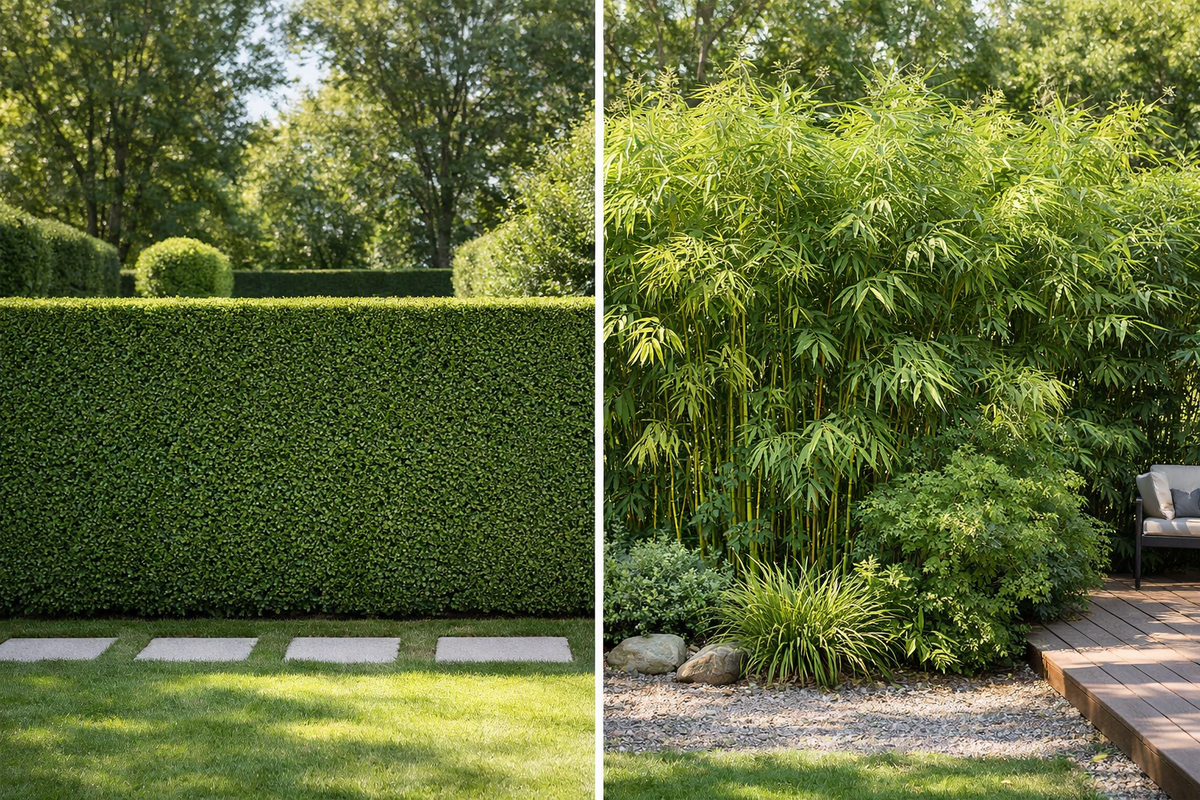
If you’ve ever shopped for “privacy plants,” you’ve probably seen the words hedging and screening used like they mean the same thing. They’re related—but not identical. Choosing the right approach can save you a lot of time (and money) because hedges and screens behave differently, look different, and need different levels of maintenance.
Think of it like this, hedging is a haircut you maintain, while screening is a barrier you build. Both can give privacy, but they suit different spaces and different people.
What Is Hedging?
A hedge is a row (or mass) of plants grown and maintained to form a dense, consistent shape—usually a straight line with a uniform height and width. The defining feature of hedging isn’t the plant itself; it’s the way you manage it.
Hedging plants are chosen because they:
-
respond well to regular trimming
-
branch densely after pruning
-
can be shaped into clean lines (or formal topiary)
What a hedge gives you:
-
a polished, structured look
-
privacy at a specific height
-
a “green wall” that looks intentional and architectural
The trade-off: hedges typically require regular pruning to stay dense and crisp. Skip the trims, and many hedges get leggy, uneven, or too wide.
What Is Screening?
A screen is planted designed primarily to block views, filter wind, or create separation—often with a more natural shape and less frequent trimming. Screening can be a single row, layered planting, or even plants in planters.
Screening plants are chosen because they:
-
grow upright and tall
-
hold foliage well (so they don’t go bare at the base)
-
create coverage quickly
What a screen gives you:
-
privacy and separation (often faster than a formal hedge)
-
a softer, more natural feel
-
flexibility in height and density without constant shaping
The trade-off: screening can be less “perfect” than hedging, and some screens shed leaves, drop litter, or need occasional thinning.

Key Differences: Hedging vs Screening (In Plain English)
1.) Maintenance
-
Hedging: higher maintenance (regular trims keep it dense and neat)
-
Screening: lower maintenance (light shaping or thinning occasionally)
2.) Look and Style
-
Hedging: formal, clean, geometric
-
Screening: softer, more natural, often layered
3.) Speed to Privacy
-
Hedging: can be fast, but density depends on pruning and time
-
Screening: often faster at blocking views, especially with taller plants
4.) Space
-
Hedging: can be kept narrow with consistent trimming
-
Screening: some screening plants want more width, especially if left natural
5.) Purpose
-
Hedging: boundaries, structure, “designed” lines, curb appeal
- Screening: privacy, wind filtering, noise buffering, zoning spaces
Which One Do You Need? Ask These 4 Questions
-
Do you want a crisp, “architectural” line?
If you want something that looks like it belongs in a magazine—straight, level, and tidy—go hedging. -
How much time do you want to spend pruning?
If you hate trimming or want a set-and-mostly-forget solution, go screening. -
What are you trying to block—eye-level views or higher overlooking?
For blocking second-storey sightlines, taller screening plants (or screening in planters) often win because they build height quickly. -
How much width do you have?
If the space is tight (beside paths, driveways, narrow side yards), a hedge that can be trained narrow might suit better than a wide natural screen.

Popular Choices for Each (Examples)
Good hedging options (when maintained):
-
Lilly Pilly (selected hedge varieties)
-
Westringia (especially for coastal, low-water looks)
-
Box-style shrubs (where suitable)
-
Photinia (for colourful, clipped hedges)
Good screening options (less trimming):
-
Clumping bamboo (for tall, vertical privacy)
-
Viburnum (soft, fast screening when lightly shaped)
-
Layered native shrubs (for wildlife-friendly screens)
-
Screening in planters (great for courtyards and paved areas)
A pro move is combining both, hedge for the front boundary (clean curb appeal) and screening for side/back privacy where you want height and softness.

Final Takeaway
If you want clean lines and a formal look, you need hedging—and you’ll be signing up for trimming to keep it dense. If you want privacy with less fuss, you need screening—often taller, softer plants that do the blocking without constant shaping.
And if you’re still stuck, here’s the simplest rule:
Choose hedging for style. Choose screening for function.
(Or mix both for the best of both worlds.)